
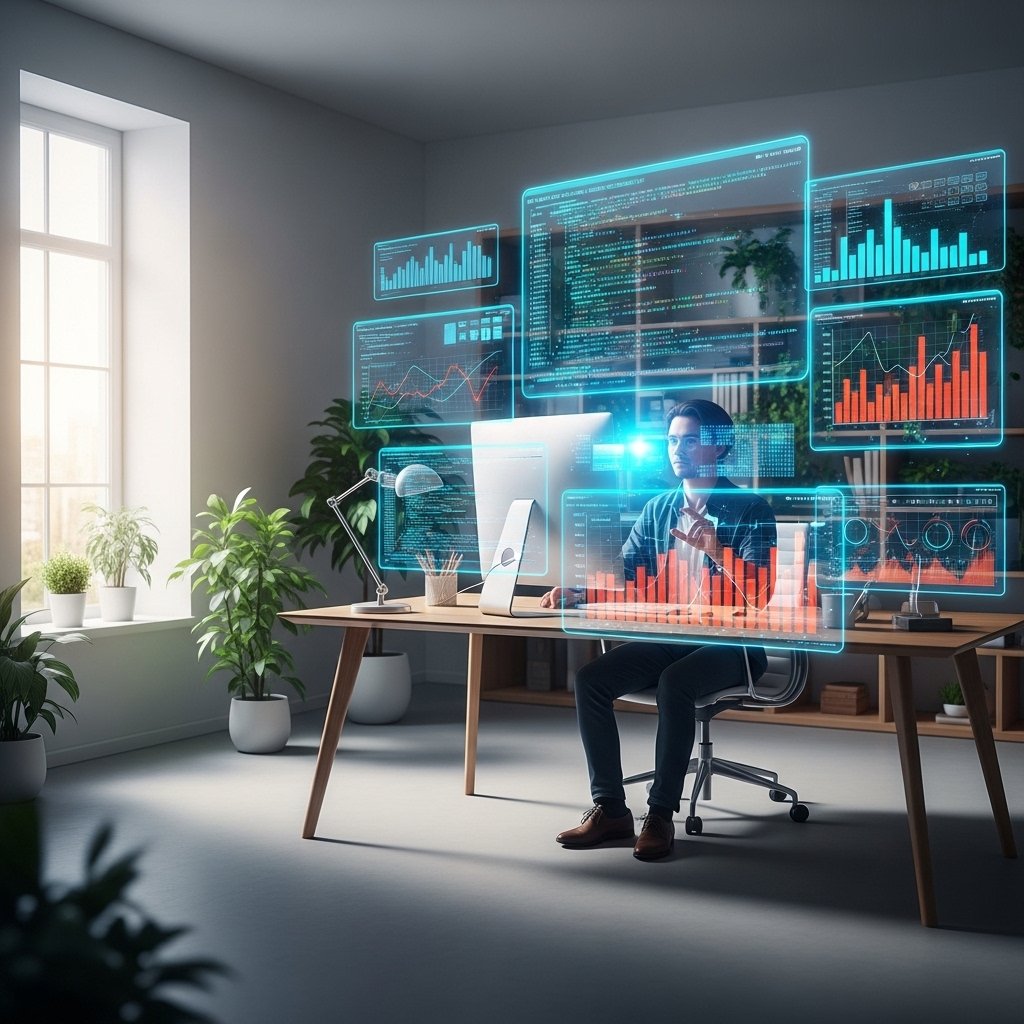
The year 2026 marks the end of an era for the traditional “9-to-5” physical office. While the early 2020s were defined by the struggle between “Work from Home” and “Return to Office,” the maturity of Metaverse technology and Spatial Computing has introduced a superior third option. Today, global corporations are abandoning expensive downtown real estate in favor of persistent, high-fidelity virtual headquarters that offer the collaboration of an office with the comfort of home.
The Rise of the Spatial Workspace
In 2026, we have moved beyond the “clunky” VR headsets of the past. Modern Spatial Glasses are as light as traditional eyewear, allowing employees to remain in a virtual office for hours without fatigue. These digital workspaces are not just cartoons; they are hyper-realistic 3D environments where you can sit next to a colleague from London while you are in Dubai.
The advantage is “Presence.” Unlike a 2D Zoom call where you are looking at a gallery of faces, the Metaverse allows for spatial audio and body language. If a teammate whispers to your left, you hear them from your left. If they point at a 3D data model floating in the center of the room, everyone sees exactly what they are pointing at. This level of immersion has restored the “water cooler moments”—those accidental, creative conversations that were lost during the early years of remote work.
AI Co-Workers: The New Members of the Team
The most significant shift in the 2026 workforce is the integration of “Autonomous AI Agents” as full-fledged team members. These are not just chatbots; they are digital entities with specific roles. You might have an “AI Project Manager” that automatically tracks deadlines and reallocates resources, or an “AI Researcher” that summarizes thousands of pages of industry data in seconds.
The role of the human employee has evolved from “doing the work” to “directing the work.” In this new economy, the most valuable skills are no longer technical execution, but prompt engineering, strategic thinking, and emotional intelligence. Humans handle the complex ethical decisions and creative leaps, while AI handles the high-volume data processing and administrative coordination.
The Global Talent Marketplace and the “Digital Nomad”
Because physical location no longer matters in 2026, the global talent pool has exploded. A small startup in Mogadishu can now hire the world’s best engineers from Canada, Brazil, and Singapore without worrying about visas or relocation costs. This has led to a more equitable global economy where skill—not geography—is the primary currency.
Furthermore, the concept of a “workday” has become fluid. With asynchronous AI tools keeping projects moving 24/7, employees are free to choose their own hours. This “Digital Nomad” lifestyle has revitalized rural areas and smaller cities, as people no longer need to crowd into expensive, polluted “Mega-Cities” to find high-paying tech jobs.
Conclusion: A Human-Centric Future
As we look at the landscape of 2026, the “Virtual Office” is more than just a technological upgrade; it is a tool for human liberation. By eliminating the daily commute and the physical constraints of the office, we have gained back hours of our lives each day. For the OviTech community, the message is clear: the future of work is not about being “somewhere,” but about being “connected.” The office is no longer a place you go—it’s an experience you enter.