
The Race to 6G: How Ultra-Fast Connectivity Will Change the World by 2030
As of 2026, the global conversation around telecommunications has shifted from the incremental improvements of 5G to the radical possibilities of 6G. While 5G focused on connecting phones and basic IoT devices, 6G is being designed to connect the human senses with the digital world. This article explores how 6G technology is set to redefine reality, industry, and human interaction by the end of this decade.
What Exactly is 6G Technology?
At its core, 6G (sixth-generation wireless) is the successor to 5G cellular technology. It is expected to operate at higher frequencies, specifically in the terahertz (THz) band. This allows for data speeds that were previously unimaginable—potentially reaching 1 terabit per second (Tbps). To put that into perspective, you could download 100 high-definition movies in a single second.
However, speed is only one part of the story. 6G focuses on “Micro-latency,” reducing the delay in data transmission to less than a microsecond. This near-instantaneous communication is what will allow machines and humans to work together in perfect synchronization.
The Rise of Holoportation and 3D Reality
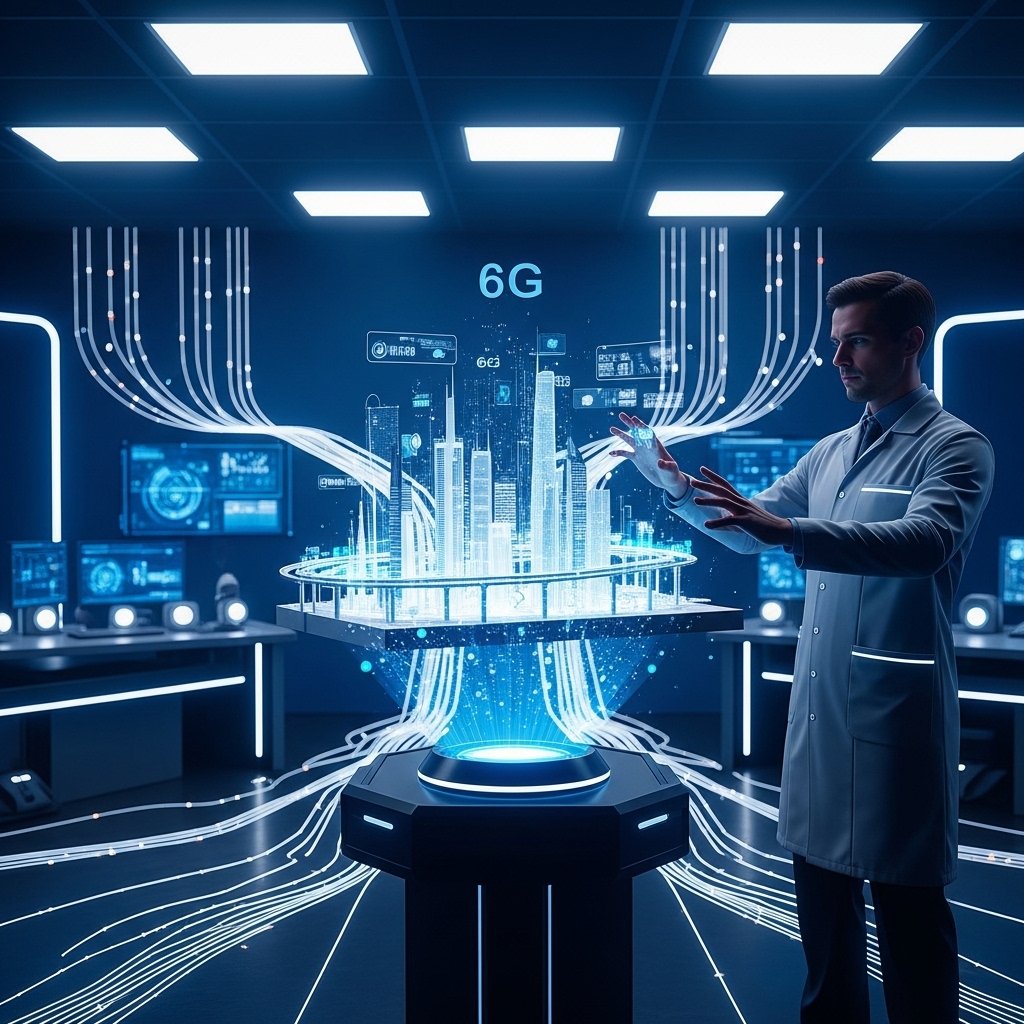
One of the most anticipated features of 6G is the ability to support high-fidelity holograms. Current video conferencing, like Zoom or Teams, is limited to 2D screens. With 6G’s massive bandwidth, “Holoportation” will become a reality. This technology allows a full-sized, high-resolution 3D digital twin of a person to be projected into a room thousands of miles away.
Imagine a business meeting where your colleagues from Tokyo, London, and New York are all sitting around the same physical table in your office, despite being on different continents. This will not only revolutionize the corporate world but also education, allowing students to attend lectures from the world’s greatest professors in an immersive 3D environment.
Transforming Healthcare: Remote Surgery and Bio-Connectivity
The impact of 6G on the medical field will be life-saving. While 5G enabled basic remote consultations, 6G will provide the stability and speed required for “Telesurgery.” A specialist surgeon in a major city could control a robotic arm in a rural clinic to perform a complex heart surgery. The zero-latency nature of 6G ensures that the robot mimics the surgeon’s hand movements with absolute precision.
Furthermore, 6G will integrate with “Internet of Bodies” (IoB) technology. Small, 6G-connected sensors could be implanted or worn to monitor blood chemistry, organ function, and neural activity in real-time. This data would be analyzed by AI to predict a heart attack or a stroke days before it happens, moving healthcare from “treatment” to “total prevention.”
The Infrastructure Challenge
Transitioning to 6G is not as simple as changing a SIM card. It requires a complete redesign of network infrastructure. Because terahertz waves have a short range and can be blocked by physical objects like walls or even rain, 6G will rely on “Distributed Antenna Systems” and “Reconfigurable Intelligent Surfaces” (RIS). These are smart materials built into the walls of buildings that can reflect and direct 6G signals to ensure constant coverage.
Conclusion: A World Without Borders
The 6G revolution represents more than just a faster internet connection; it is the final bridge between the physical and digital worlds. By 2030, the concept of “going online” will likely disappear because we will be constantly and seamlessly connected to a global intelligence network. As we navigate the complexities of 2026, the foundations for this hyper-connected future are already being laid.